
CELEBRITY
BREAKING: TRUMP’S JUSTICE DEPARTMENT FIRES WARNING SHOT AT ELIZABETH WARREN! U.S. ATTORNEY AARON REITZ DEMANDS SHE PRESERVE EVERY EMAIL, MESSAGE AND DOCUMENT AS HE ACCUSES HER OF PLOTTING TO USE CONGRESS AGAINST TRUMP ALLIES — NOVEMBER 23 DEADLINE SET! 👀⚖️

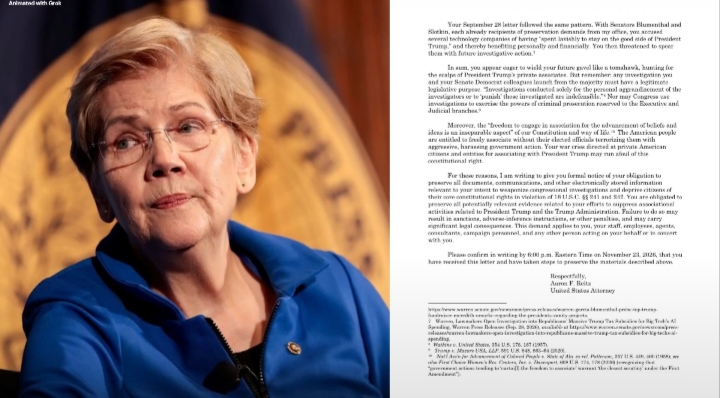
Washington has been thrown into another political storm after U.S. Attorney Aaron Reitz issued a formal legal preservation notice to Democratic Senator Elizabeth Warren, demanding that she preserve records connected to her publicly discussed plans to investigate individuals and businesses associated with President Donald Trump.
The extraordinary development has added another layer of tension to the increasingly bitter confrontation between congressional Democrats and the Trump administration, raising fresh questions about where legitimate government oversight ends and political retaliation begins.
And this time, Warren is directly in the spotlight.
A LEGAL WARNING WITH A NOVEMBER 23 DEADLINE
In his letter, Reitz accused Warren of preparing to use congressional investigative powers against people whose primary connection to the potential investigations is their association with President Trump.
He argued that Americans should be free to support, associate with and conduct business with political figures without fearing that those relationships could expose them to government harassment.
The prosecutor did not mince his words.
In one particularly striking passage, Reitz accused Warren of being eager to wield her future committee gavel “like a tomahawk, seeking the scalps of those who associate ‘too closely’ with President Trump.”
He also warned that congressional investigations conducted for personal advancement or to punish individuals rather than serve a legitimate legislative purpose would be indefensible.
The letter cites two federal statutes, 18 U.S.C. Sections 241 and 242, which address conspiracies against constitutional rights and the deprivation of rights under colour of law.
However, the distinction is important: the preservation notice does not mean Warren has been charged with a crime or that a court has determined she violated either statute.
EVERY EMAIL, MESSAGE AND DOCUMENT MUST BE PRESERVED
Perhaps the most significant aspect of Reitz’s demand is its broad scope.
The preservation notice reportedly covers Warren herself, her Senate staff, consultants, campaign personnel and other individuals acting on her behalf.
It calls for the preservation of relevant documents, electronic communications and other records connected to her plans and intentions concerning investigations into Trump associates.
Reitz has given Warren until 6 p.m. Eastern Time on November 23 to confirm in writing that she has received the notice and taken the necessary steps to preserve the materials.
Failure to preserve relevant evidence could potentially lead to legal consequences.
For a senator preparing to exercise significant congressional oversight authority, the demand creates an uncomfortable legal and political confrontation.
WARREN’S INVESTIGATIVE PLANS NOW UNDER SCRUTINY
The controversy comes as Democrats prepare to exercise greater congressional oversight following their recent midterm election victories.
Warren has discussed investigating powerful business interests and individuals connected to the Trump administration.
Her supporters could argue that examining potential conflicts of interest and the relationship between political influence and private business is a legitimate responsibility of Congress.
Reitz, however, believes that investigations targeting people simply because of their political associations could cross a constitutional boundary.
That disagreement is now at the centre of the dispute.
WHAT HAPPENS NEXT?
The November 23 deadline is likely to attract considerable attention as Washington watches to see how Warren responds.
Will she comply with the preservation demand while defending her congressional investigative authority? Will she challenge Reitz’s legal position? Or could this confrontation develop into another prolonged battle over the constitutional powers of Congress and the executive branch?
For now, no criminal finding against Warren has been announced.
But one thing is clear: the disagreement over how far congressional investigations can go has moved beyond political speeches and into a formal legal confrontation.
And with other Democratic lawmakers also receiving similar warnings from Reitz, this could become a much bigger Washington battle than anyone initially anticipated.
The question now is whether the two sides can establish where constitutional oversight ends and alleged political retaliation begins.

King Charles Overcome With Emotion as Meghan Markle Stuns Him With an Unexpected Palace Visit Alongside Archie and Lilibet for His 78th Birthday While Prince Harry Travels to Ukraine! But When Little Lilibet Asks Her Grandfather to Kneel for a Special Birthday Prayer Before Presenting Their Mysterious Gifts, Charles’ Tearful Reaction Leaves Everyone SPEECHLESS

BREAKING: President Trump returns to the White House after hiding over threats of drone assassination attacks, but one detail about his arrival raises bigger questions about whether the threat was a lie all along

JUST IN: King Charles Left SOBBING After Receiving Devastating News About Prince Harry in Ukraine! His Heartbreaking Reaction Has Left Royal Fans in Tears, as One Palace Insider Reveals the Painful Words King Charles Could Barely Bring Himself to Say…

MINUTE AGO: King Charles III issues an URGENT address to the entire UK amid overwhelming grief, his voice trembling as he reveals: “My son has…

Kate Middleton joins Prince William in first overseas royal tour amid her cancer recovery

Harry has consulted lawyers to discuss a royal “post-nuptial agreement” as the Duke desperately seeks to repair relationship with King Charles III

JUST IN: Peter Phillips, 49, Shares FIRST OFFICIAL Wedding Photos With Harriet Sperling — Royal Fans Can’t Stop Talking! ❤️💍

PRINCE WILLIAM AND KATE MIDDLETON CAUGHT IN A DEEPLY INTIMATE BEACH MOMENT! 😍❤️ The Princess of Wales Wraps Her Arms Around Her Husband as William Lets Out a Joyful Scream in Rare, Unfiltered Footage That Has Royal Fans Swooning!

BREAKING: ELON MUSK BREAKS HIS SILENCE AFTER FLORIDA GOVERNOR RON DESANTIS INVITED HIM TO BRING HIS TESLA GIGAFACTORY TO FLORIDA AMID THE ONGOING CHAOS BETWEEN HIM AND TEXAS GOVERNOR GINA HINOJOSA.

Trump Blames Biden Administration for FAA Ground Stop While Breaking His Silence on Nationwide Crisis

BREAKING: TRUMP’S WHITE HOUSE HEALTH SCARE CLAIM SPARKS OUTRAGE! Viral Reports Claim President Passed Out During Friday Night Speech as Questions About His Health Ignite Fierce Political Debate!
