
CELEBRITY
The Trump Administration’s $1.7 Billion National Guard Deployments Fail To Reduce Urban Crime

The second Trump administration is trying to take credit for the historic drop in violent crime across America despite the fact that this trend began before it took office, and it is using these declines to justify expanding policies that are unpopular, ineffective, and costly.1 Even though the data clearly show that violent crime and homicides were already dropping in American cities in 2023 and 2024, the Trump administration has continued to threaten city and state leaders and argue that its extreme actions, such as deploying the National Guard to support law enforcement operations, are improving public safety.2
The Trump Administration’s $1.7 Billion National Guard Deployments Fail To Reduce Urban Crime
New CAP analysis reveals the Trump administration’s costly National Guard deployments have failed to reduce violent crime despite its claims of success.
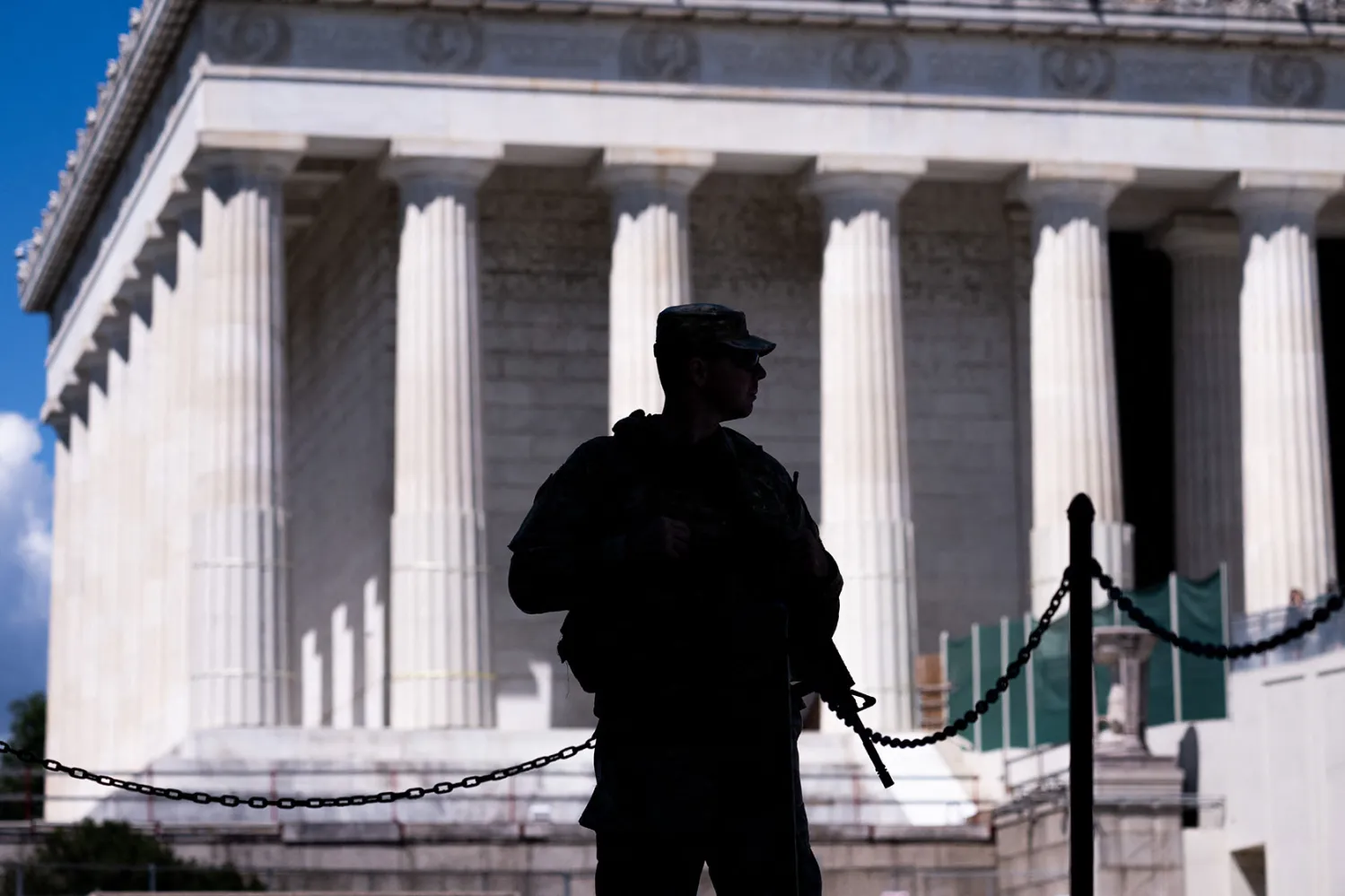
Armed National Guard member foregrounded in silhouette in front of pillars of Lincoln Memorial
Armed members of the National Guard patrol on the National Mall near the Lincoln Memorial in Washington, August 26, 2025. (Getty/Saul Loeb)
Introduction and summary
The second Trump administration is trying to take credit for the historic drop in violent crime across America despite the fact that this trend began before it took office, and it is using these declines to justify expanding policies that are unpopular, ineffective, and costly.1 Even though the data clearly show that violent crime and homicides were already dropping in American cities in 2023 and 2024, the Trump administration has continued to threaten city and state leaders and argue that its extreme actions, such as deploying the National Guard to support law enforcement operations, are improving public safety.2
However, new Center for American Progress analysis finds no evidence that National Guard deployments have reduced violent crime. Moreover, if these deployments are extended and continue through the end of 2026, they could cost American taxpayers more than $1.7 billion.
Background
In June 2025, in response to resistance against the federal immigration enforcement surge, President Donald Trump federalized California’s National Guard and deployed 2,000 guardsmen, along with 700 U.S. Marines, to Los Angeles to “protect ICE and other United States Government personnel who are performing Federal functions.”3 Although this initial deployment was limited in scope, it served as a road map for subsequent authoritarian power grabs in American cities that Trump had been threatening for years.4 Just two months later, on August 11, 2025, President Trump federalized Washington, D.C.’s, police force and sent an initial 800 National Guard troops to the city, declaring a “crime emergency,” despite violent crime in the city being at a 30-year low in 2024.5 Since then, Trump has authorized the deployment of National Guard troops and other federal agents to four more cities—Portland, Oregon; Chicago; Memphis, Tennessee; and New Orleans. He has also threatened to send the National Guard to five additional cities—Baltimore; New York City; St. Louis; San Francisco; and Oakland, California—under the similar pretense of addressing crime and violence.6
Because the president’s legal authority to justify these deployments was questionable, nearly all met immediate legal challenges.7 For example, although the Trump administration sent the National Guard to the Chicago and Portland areas, courts blocked those troops from having an active presence in those cities.8 Facing public backlash and judicial opposition, in a December 2025 social media post, President Trump announced the withdrawal of National Guard troops from all cities except Memphis; New Orleans; and Washington, D.C.,9 by February 2026. Nevertheless, the president has continued to assert that these deployments, along with other federal agent surges focused on immigration enforcement, have reduced crime and made Americans safer.10 At a public roundtable in Memphis in March, Trump claimed that the Memphis Safe Task Force, which sent federal agents and the Tennessee National Guard to Memphis, “stopped crime.”11
In an effort to falsely claim his policies have reduced crime, the president is exploiting the fact that violent crime and murder were already declining in the cities his administration targeted with these extreme interventions. On average, the 11 cities where the National Guard was deployed or threatened to be deployed saw a 14 percent decrease in their 12-month rolling violent crime rate and a 22 percent decrease in their 12-month rolling murder rate from June 2024 to June 2025, before the National Guard was first deployed to Los Angeles.
These recent violent crime trends, predating even Trump’s second inauguration, suggest that, more than likely, violent crime would have continued trending downward in these cities by the end of 2025, regardless of any additional interventions. However, the Trump administration has ignored this fact when reporting year-over-year crime statistics to claim these extreme tactics have made Americans safer.12 Instead of acknowledging that violent crime and homicides have been declining at historic rates since 2023 in most American cities, the Trump administration is disregarding the longer-term trend that began before it took office.13 Any real attempt to understand if these tactics have meaningfully affected crime rates or trends in American cities requires deeper analysis, taking into account the preexisting trend before the National Guard were deployed to the targeted cities.
Recent analyses of National Guard deployment in Washington, D.C., indicate that this strategy has not affected violent crime or shootings.14 But those studies did not use a comprehensive set of data points covering the full deployment periods across all affected cities to determine whether the deployments had a measurable effect on crime trends. New CAP analysis does, however, and provides the strongest evidence to date that the Trump administration’s unpopular and costly deployment of National Guard personnel to American cities has had no measurable effect on the rates of violent crime, homicide, or gun violence.